A hybrid anime recommender built on 23.2M real list interactions. It handles brand-new visitors and titles nobody has rated yet, and was tested on a held-out time window.
Popularity lists ignore your taste. Collaborative filtering ignores new shows.
AnimeRec ranks every eligible title for each visitor. It leans on what similar viewers enjoyed, then shifts smoothly toward synopsis and metadata signals as a title’s history falls to zero. Answer three quick questions and your top 10 appears instantly, with no retraining and a reason attached to each pick.
A personal top 10, with the reason behind the lead recommendation.Challenge & solution
What made it hard, and how I approached it.
The challenge
An evaluation that could be trusted
Collaborative filtering cannot rank a title nobody has watched yet.
The newer dataset looked ideal, but 97.0% of 9.8M sampled “interaction dates” were really air dates or placeholders.
Anime viewing follows the airing season, so a plain popularity baseline makes any model look better than it is.
The solution
Real timestamps, a harder baseline
Switched to a crawl with per-user update times, then joined synopses from the newer dataset by anime ID.
Split globally by time and ranked the full 10,720-title catalog, with no negative sampling and the test window scored only once.
Each title blends collaborative and content scores by how much history it has, and results are reported against recent popularity too.
Key features
Built around what people actually need.
Instant taste profile
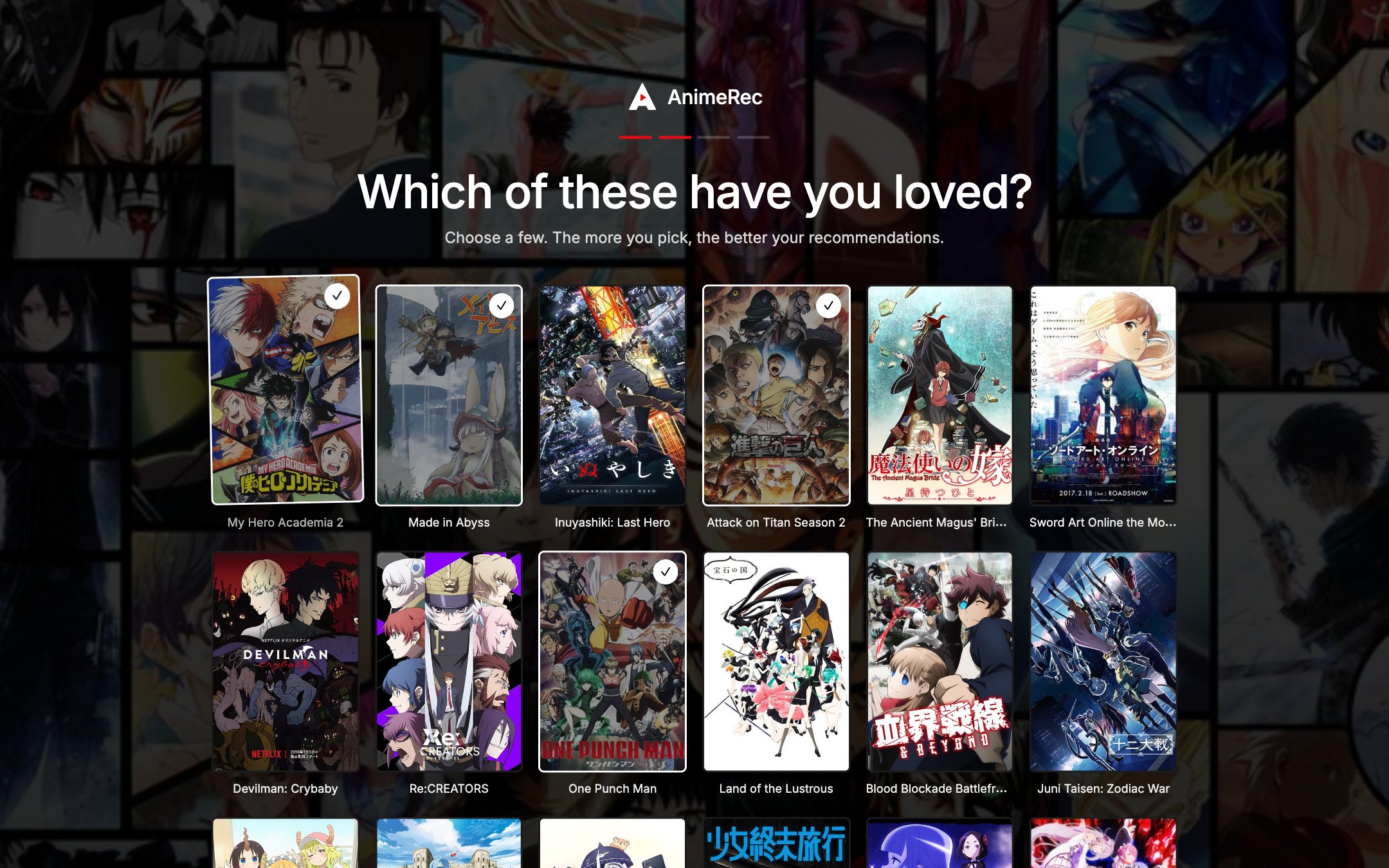
Pick genres and a few favourites, and new users are folded into the model on the spot, without retraining.
A reason for every pick
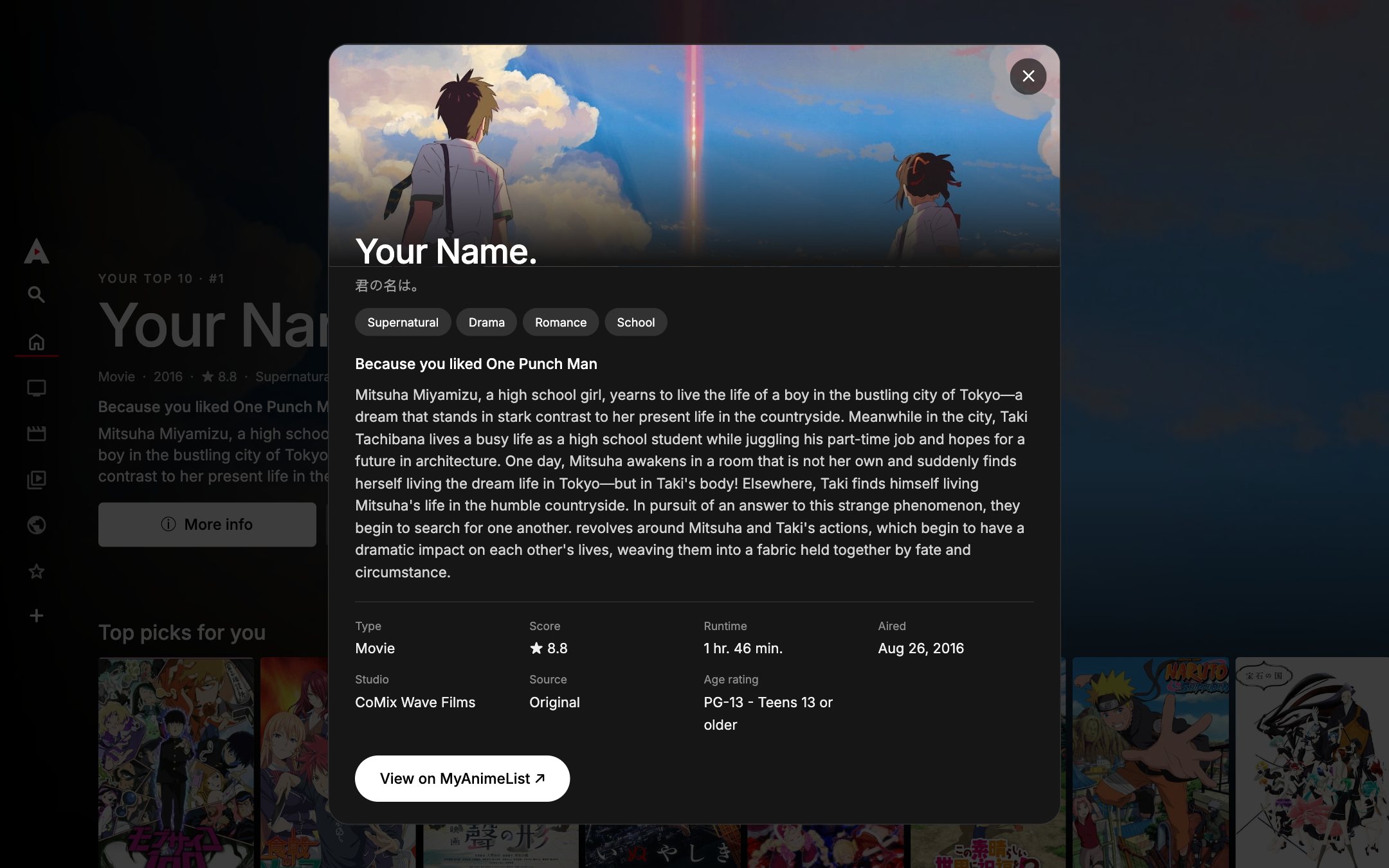
Recommendations say why they are there, like “Because you liked One Punch Man”, and every title opens a detail card.
Room for new titles
A title with no viewing history can still be scored from its synopsis, genres, studio, type and year.
Responsive
Made for browsing on a phone
On small screens the side rail becomes a floating bottom pill, and the picks stay within thumb reach.
Floating bottom navigation on phones
Answers are remembered in the browser, with no account
Sequels of titles you already picked stay hidden by default
In the data
What the test window actually showed.
All three charts use the frozen final run: 25,193 users, the full catalog of 10,720 titles, and activity from February to April 2018 that no model saw during training or tuning.
Model comparison
63% above recent popularity, and level with EASE.
The hybrid scores 0.1517 NDCG@10, against 0.0929 for recent popularity, the stronger baseline, and 0.0368 for all-time popularity. Plain EASE is effectively tied at 0.1521, so the hybrid’s value is reaching titles EASE cannot score.
Source: reports/results.md, test window 2018-02-01 to 2018-05-01. Lift over recent popularity: 95% bootstrap CI +60.6% to +66.2%.
User history
Ahead for every length of watch history.
The hybrid leads both baselines in all five groups. The gap is narrowest for the 101 users with five titles or fewer, where popularity is still a strong guess.
Source: failure analysis in reports/results.md. NDCG@10 by number of titles in a user’s earlier history.
New titles
It can rank new titles, but they rarely reach a top 10.
Among titles with no history, the content signal is the only one that works. Toggle to the full catalog: they take just 0.27% of recommendation slots, so this problem is only partly solved.
Source: reports/results.md, 341 cold titles and 938 users with a relevant cold title. Both views share one scale.
Screens
A closer look at the product.
Onboarding: pick a few titles you lovedEvery title opens a detail card with its reasonShelves filter your top picks by format
How it works
Under the hood.
Data23.2M interactions from 100,000 sampled users, after logged filters removed bulk imports and bot-like accounts.
ModelsEASE and ALS for collaborative filtering, and all-MiniLM-L6-v2 sentence embeddings with metadata for content.
HybridPer title, alpha = n / (n + κ) moves the score from collaborative to content signals as its history n falls to zero.
DemoA Streamlit app in Docker behind a Cloudflare Tunnel, serving the same model that was evaluated.
The most useful step came before any model: auditing the timestamps. It stopped me from reporting a time split that was not really one. It also taught me to publish the less flattering numbers. The hybrid only matches plain EASE overall, and new titles rarely reach a top 10.
 ← All projects